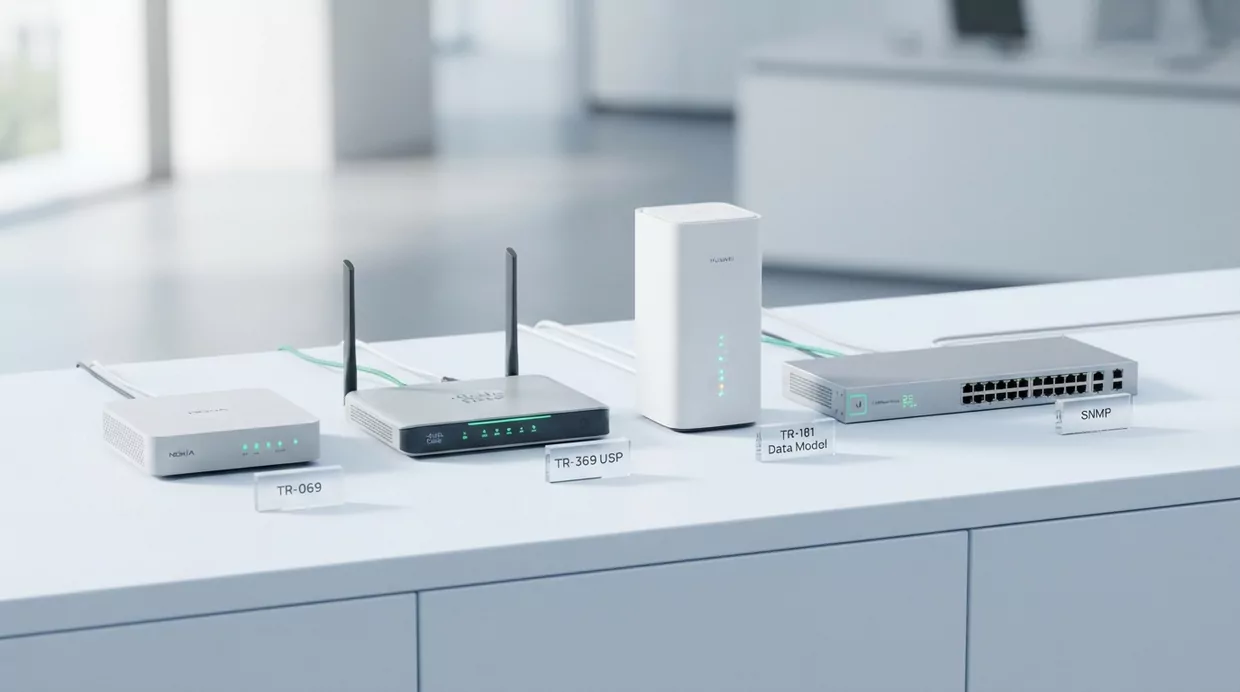
CPE and protocol coverage
Which equipment AutoConfigPro drives, over which protocols, and against which data models.
Makers in a typical fleet
A badge does not decide whether a model is covered — the data model it exposes does, which is why we answer per model rather than per maker.
- Sagemcom


- Technicolor
- AVM


A fleet from a dozen vendors, operated as one
TR-069 gives every CPE that implements it the same vocabulary — not the same answers. Two gateways from different vendors expose different parameter trees, part of your fleet carries an older model, and some of it does not speak TR-069 at all. The platform absorbs that difference instead of pretending it is not there.
Equipment under management
Fibre ONT and ONU
Optical terminals at the subscriber end of a GPON or XGS-PON access network.
xDSL and cable gateways
VDSL2 and cable residential gateways, including the installed base still exposing the legacy data model.
4G and 5G fixed wireless
FWA routers and cellular backup appliances that report in over the mobile network.
Wi-Fi gateways and mesh
Residential gateways, access points and mesh satellites, down to per-radio and per-SSID settings.
Business routers and SD-WAN
Branch and enterprise appliances, where one bad configuration is a site outage.
Equipment that does not speak TR-069
Older or specialised devices reached over SNMP or NETCONF, driven from the same console as the rest.
Protocols and data models
- TR-069 (CWMP) The management protocol itself: Inform, parameter reads and writes, reboot, firmware download.
- TR-181 (Device:2) The current Broadband Forum data model. Its tree is rooted at Device., and it is what new equipment is designed against.
- TR-098 (InternetGatewayDevice) The model it replaced, rooted at InternetGatewayDevice. Equipment built against it is still in service, which is why both paths matter below.
- TR-369 (USP) The successor to CWMP, for the equipment that has moved across to it.
- SNMP · NETCONF For the part of the fleet that sits outside the Broadband Forum stack.
Why a mixed fleet stays manageable
The device describes itself
A CPE announces itself with an Inform when it boots. AutoConfigPro then reads its parameter tree instead of assuming one: what a given model actually exposes is what the platform offers you for it.
One intent, the right parameter path
Changing an SSID is a single action in a workflow. Underneath, the platform writes to whichever path the device understands.
TR-181Device.WiFi.SSID.{i}.SSIDTR-098InternetGatewayDevice.LANDevice.{i}.WLANConfiguration.{i}.SSIDYour team never writes either path.
Vendor extensions are kept, not flattened
Manufacturers add their own X_VENDOR parameters on top of the standard tree. Those stay readable and writable, so a model-specific capability is not lost to the lowest common denominator.
What a device needs for any of this to work
- An address to call The CPE opens the session, never the other way round, so it has to know where to call. That address reaches it in the factory image, from DHCP on the access network, or written once over the management channel it already has.
- Credentials, and a certificate it trusts CWMP authenticates in both directions and the session runs over TLS. Firmware that cannot validate your certificate chain is the common reason a device that should be manageable is not.
- A way to be reached between check-ins To pull a device in before its next scheduled report, the ACS sends it a Connection Request. Behind carrier-grade NAT that request does not arrive; the standard defines UDP and XMPP fallbacks for that case, and failing those the device is managed on its own schedule.
- An inform interval you have chosen How often a device reports is how fresh its record is. A short interval across a large fleet costs session capacity; a long one means a drift is seen later. It is a number worth setting deliberately rather than inheriting.
Adding a new CPE model to the fleet is an onboarding step, not a development project.
Ready to automate your customer equipment?
Discover how AutoConfigPro integrates into your architecture and accelerates your telecom operations.
Targeted analysis of your CPE fleet use cases
Detailed estimate based on your active equipment count
Architecture recommendations tailored to your sovereignty needs